

Skip to content

Product tour · synthetic data · no account required

See what this month can support — from today’s work to review.

Engagement and claims tools stop at the encounter. This tour is the month they leave behind: what happened, what is held, and what still needs a person. Every example is synthetic. Coding and claims stay with you.

Kept Count · the month

Synthetic operating view

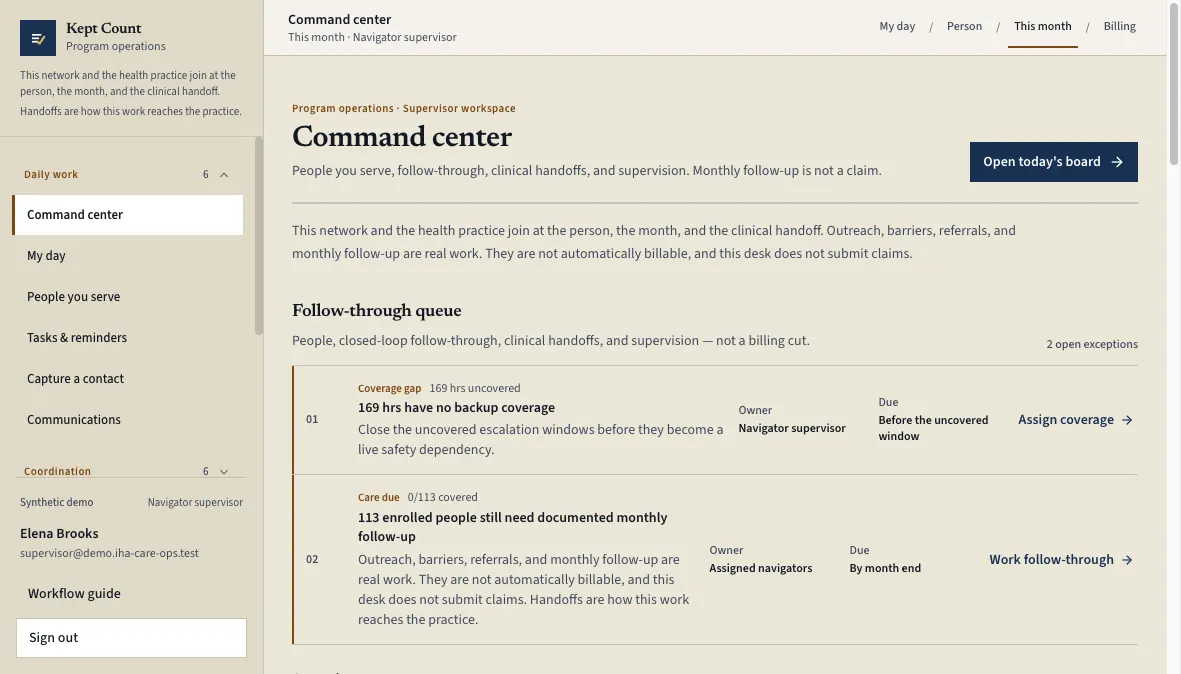
Current Kept Count console: This month follow-through queue with named owners and the month chain
Current product · This month · synthetic demo · no patient data
Illustrative photograph of today’s care-management work at a kitchen table between visits. Not Kept Count staff, customers, or patients.
A clinician and an older patient in conversation on a couch during an illustrative visit
Illustrative photography · Vitaly Gariev / Unsplash

Who the tour is for

Every step below traces back to a conversation like this one.

The panel scanner, the enrollment record, the monthly worklist, and the exception queue exist to keep that conversation—and the follow-through after it—from getting lost between systems.

  1. Step 01

    Panel intelligence

    Find the patients worth reviewing—not a list to bill.

    The scanner organizes eligibility signals, care gaps, program conflicts, QMB evidence, and missing facts into a reviewable opportunity map.

    Buyer question
    Who appears eligible, and what still needs verification?
    Authority retained
    Your team confirms patient facts, program fit, and exclusions before outreach.

    Kept Count · the month

    Synthetic operating view
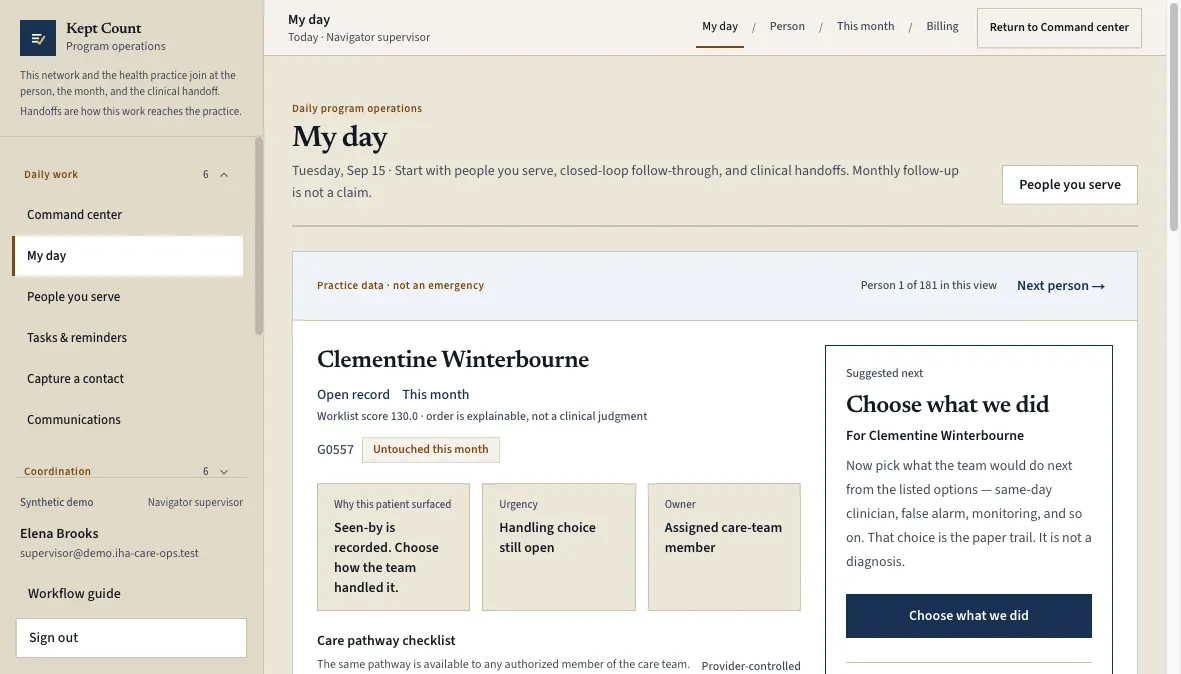
    Kept Count My day: one synthetic person, the next action, and the month chain
    Panel scanner · synthetic demo · no patient data
  2. Step 02

    Enrollment

    Make consent and patient choice visible before work begins.

    Enrollment records the outreach result, consent method, effective date, assigned team, and unresolved requirements in one traceable handoff.

    Buyer question
    Can we prove why this patient entered the program?
    Authority retained
    Approved scripts, consent policy, and enrollment decisions remain practice-controlled.

    Kept Count · the month

    Synthetic operating view
    Kept Count My day: one synthetic person, the next action, and the month chain
    Enrollment review · synthetic demo · no patient data
  3. Step 03

    Monthly care

    Run the required care operation—not a 20-minute stopwatch.

    Navigators work from a ranked day, a week calendar, and follow-through that is not a claim. Recount prepares the person from the chart and can draft Goal, Barrier, Action, and Result after the contact — a person still saves the note.

    Buyer question
    What does this patient need next, and who owns it?
    Authority retained
    The practice defines the care model, documentation standard, and clinical boundaries. Recount cannot write the ledger.

    Kept Count · the month

    Synthetic operating view

    Kept Count My day: one synthetic person, the next action, and the month chain
    Today’s worklist · synthetic demo · no patient data
  4. Step 04

    Clinical supervision

    Move exceptions to the right person before they become risk.

    Clinical needs, missing evidence, conflicting records, and out-of-scope requests are routed with context, urgency, and a named owner.

    Buyer question
    What needs clinical judgment or leadership attention?
    Authority retained
    Licensed staff retain clinical judgment, escalation authority, and final resolution.

    Kept Count · the month

    Synthetic operating view

    Kept Count this-month command center with a follow-through queue and named owners
    Exception queue · synthetic demo · no patient data
  5. Step 05

    Safeguards

    Stop unsupported work from quietly becoming a claim.

    Consent, patient facts, QMB status, configured program conflicts, service evidence, and review decisions stay visible before release.

    Buyer question
    What is supported, what is withheld, and why?
    Authority retained
    Compliance, coding, correction, and overpayment processes remain with the responsible organization.

    Kept Count · the month

    Synthetic operating view

    Kept Count this-month command center with a follow-through queue and named owners
    Release safeguards · synthetic demo · no patient data
  6. Step 06

    Billing evidence

    Give the Billing Department a review-ready packet, not a black box.

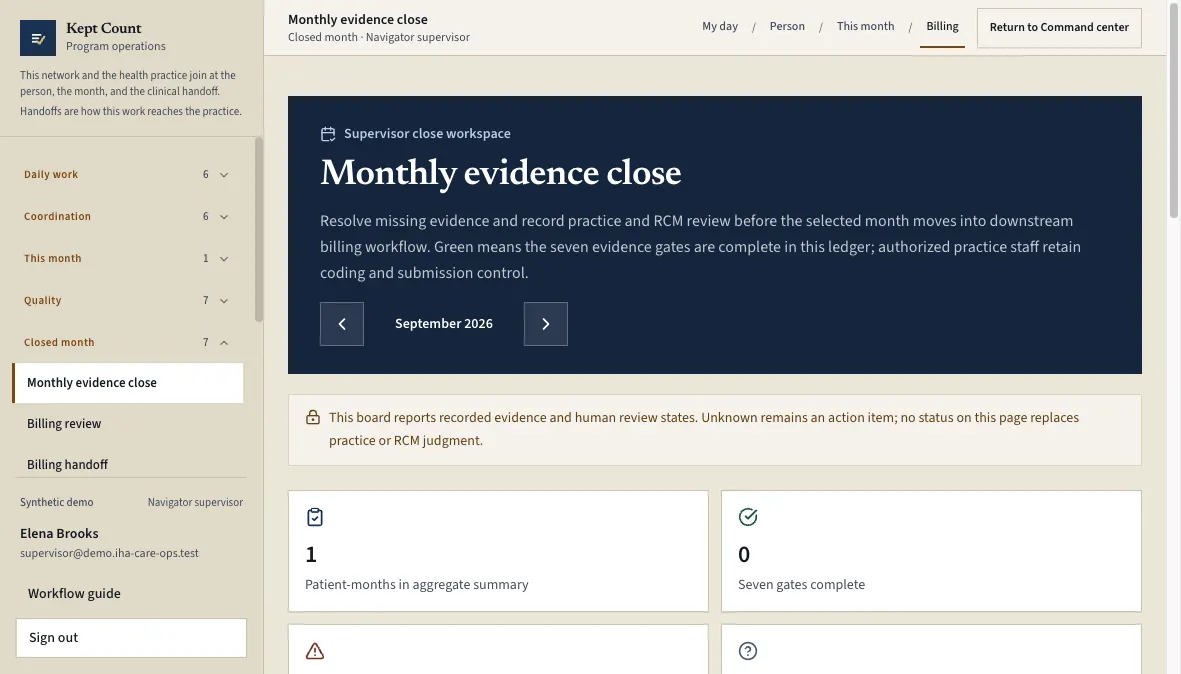
    The packet assembles the monthly operating evidence, exceptions, review history, and reason codes needed for the practice’s final billing decision.

    Buyer question
    Can the Billing Department trace the support for every proposed line?
    Authority retained
    The practice and its Billing Department or designated RCM reviewer retain final coding and claims-submission authority.

    Kept Count · the month

    Synthetic operating view

    Kept Count monthly evidence close with human-review gates before billing handoff
    Evidence packet · synthetic demo · no patient data
  7. Step 07

    Monthly close

    Keep operations, invoicing, and cash in their own lanes.

    The operating close keeps contracted capacity, activated sites, covered lives, completed monthly services, invoices issued, payment status, outcomes, and cash collected distinct. Finance-controlled states come from accounting sources—not a patient record.

    Buyer question
    Which counts are operational, which are financial, and where does each authoritative number come from?
    Authority retained
    Contract acceptance, invoice approval, payment confirmation, and finance corrections remain with the responsible organizations.

    Kept Count · the month

    Synthetic operating view

    Kept Count monthly evidence close with human-review gates before billing handoff
    Illustrative operating close · synthetic demo · no patient data

From product tour to operating plan

Now map this workflow to your practice.

The readiness brief captures your panel, team, EHR handoffs, supervision, billing workflow, and preferred operating model. It is a planning tool—not a revenue, compliance, or enrollment guarantee.

Your EHR remains the clinical system of record.

Software supports controls; it does not certify compliance.

The Billing Department or designated RCM reviewer makes the final claim decision.