Engagement platforms
Reach the patient. Capture the encounter.
They do not tell billing what this month can support.

Care between visits — for provider organizations, care networks, and approved community partners
Care-management platforms help you reach patients and file claims. Kept Count keeps the work between visits in one month — so billing, compliance, or a funder can see what is ready, what is held, and what still needs a person. Your EHR stays the clinical record. Coding and claims stay with you.
Nothing auto-submits. The fee never moves with collections. A person still has to approve.
Kept Count · the month
Synthetic operating view
Recount
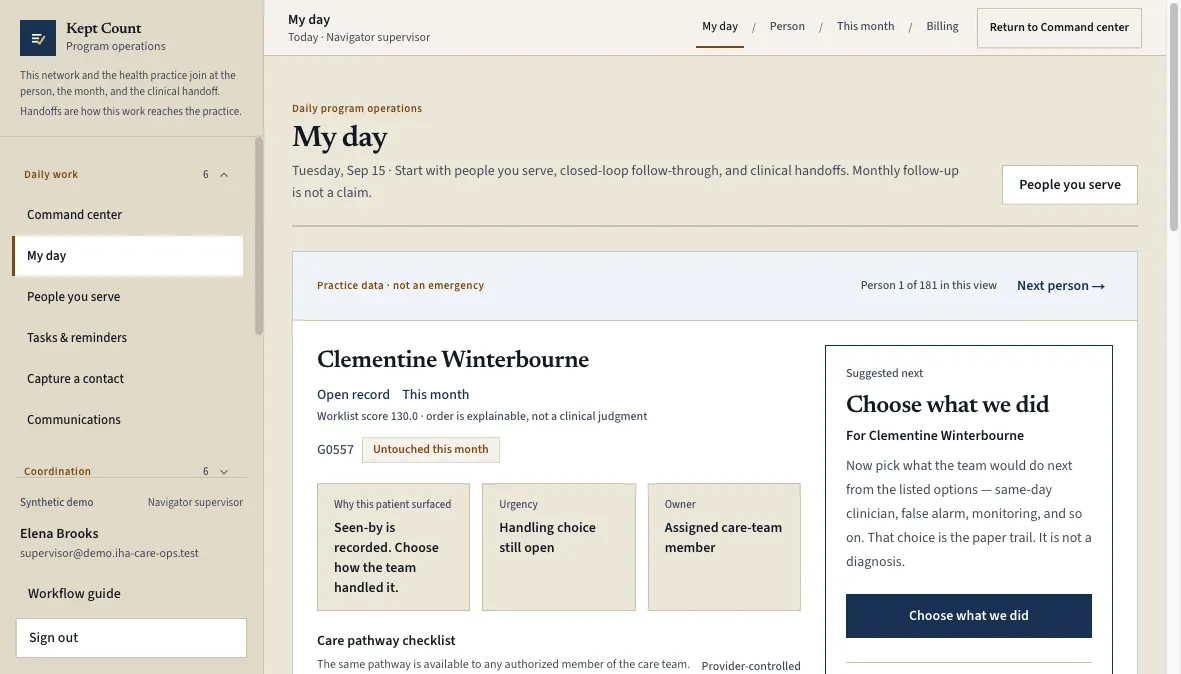
Recount is Kept Count’s own AI for the care desk — not a rented clinical-assistant brand, not an ambient scribe. It rereads the record the worker can already see, prepares the next contact, and can draft Goal, Barrier, Action, and Result into the note form.
A person still accepts, edits, or dismisses. Recount does not rank the list, send a message, pick a code, write the ledger, or replace clinical judgment. Public evaluation stays synthetic until the covered environment and agreements are in place.
Read the Recount authority boundaryChoose your path
Six kinds of organizations run care between visits. Each loses money in a different place, and each gets a different month in Kept Count.
Beside the EHR
No replacement project
Built for provider organizations
Health centers, medical groups, health systems and ACOs
Named workflows, not one stack
APCM, CHI, PIN, Health Home and related pathways stay separate
You still bill
Fixed fee; no automatic clinical or billing approval
Where we sit in the market
Engagement software helps you call, text, and enroll. Claims software helps you submit. Kept Count is the month those tools leave behind: what happened, what is still open, and what may reach review — without taking coding, claims, or clinical authority.

Engagement platforms
Reach the patient. Capture the encounter.
They do not tell billing what this month can support.
Claims and automation
Move codes. File faster.
They do not hold unsupported work before a reviewer signs.
Kept Count
One month — ready, held, or unknown.
A person still approves. The fee never moves with collections.
How the month stays intact
See what happened, what is still open, and who can move it — without rebuilding close from spreadsheets, inboxes, and separate reports.
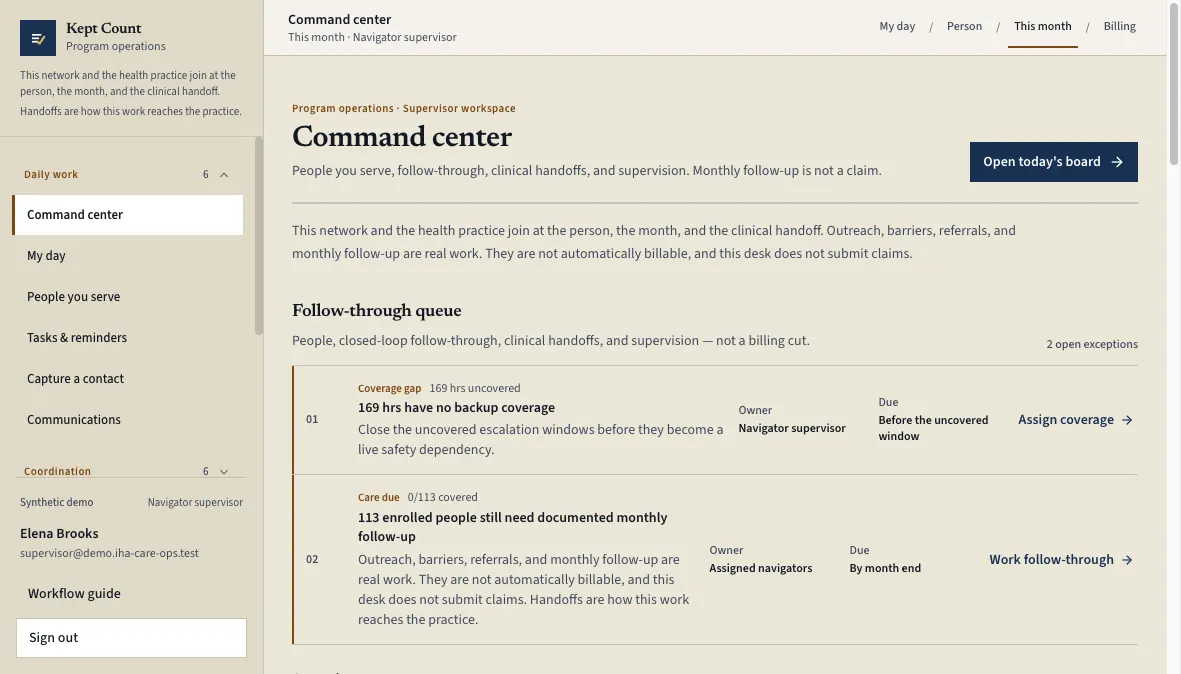
One ranked day, a week calendar, and CHW time that is not a claim. Every person has a next action — outreach, coordination, or follow-through.
Consent, program fit, missing facts, and assignment stay with the person. Recount prepares the contact from the chart before the visit counts as done.
Gaps, holds, and named owners — while the month is still open and you can still fix them.
Hand billing, compliance, or a funder what is supported, held, or unknown. Recount Review surfaces missing proof. Nothing auto-submits.
Kept Count · the month
Synthetic operating view
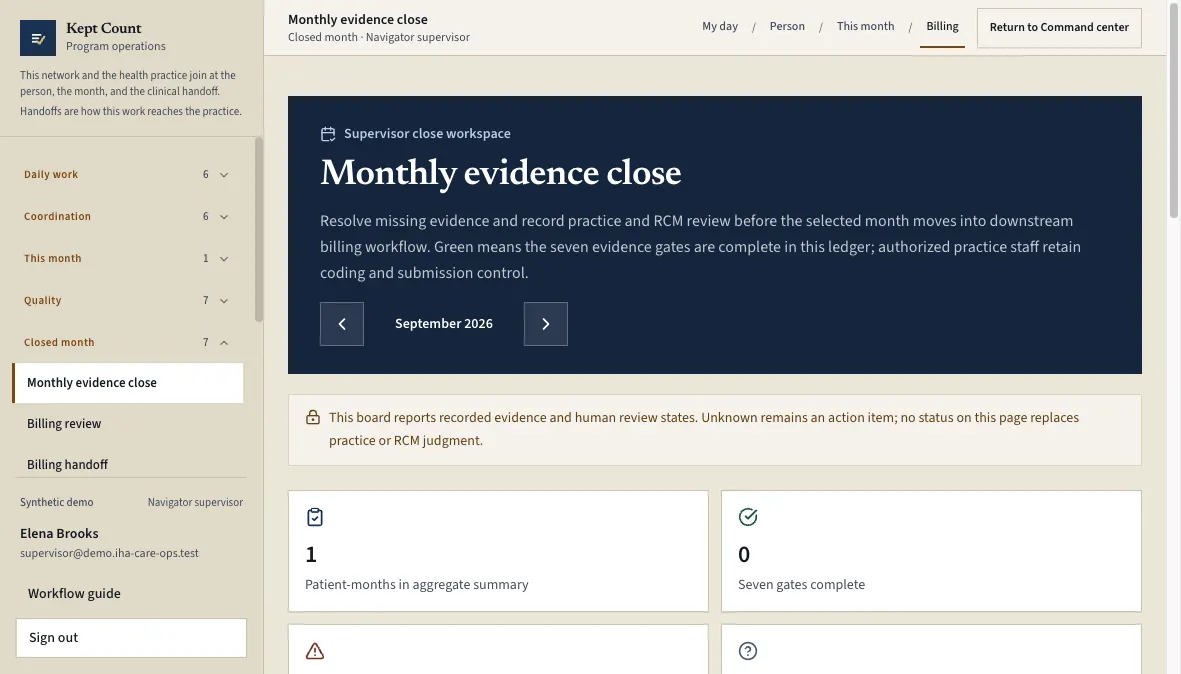
Hand someone the month — not a folder of exports.
Share the picture, then open the work, holds, and reviewer history when the team needs more than a screenshot.
Human approval stays visible at the practice and Pre-Billing boundaries.
Supported, held, and unknown states remain separate.
This month in the product
Open to coverage gaps, safety follow-up, and monthly-care pressure that still need an owner. Every item has a next action. Clinical and billing authority stay with the responsible provider.
Kept Count · the month
Synthetic operating view
Repeatable product validation
Kept Count matched every expected classification in a fixed synthetic answer manifest, including coverage, consent, missing-evidence, duplicate-month, and tier-change cases. No PHI, database, network, or persistent patient record was used.
CMS and OIG audit-response readiness
Kept Count turns practice-approved care-management requirements into visible work, named exceptions, and dated human review. If CMS, a Medicare contractor, or HHS-OIG asks for support, the evidence path is organized instead of scattered across inboxes and spreadsheets.

Configure practice-approved criteria for APCM and other supported programs, then surface missing consent, patient facts, service elements, or capability evidence for review.
Keep conflicts, duplicate-month risk, missing support, and unresolved exceptions out of the supported queue until an authorized reviewer decides.
Keep owners, dates, source references, decisions, holds, and correction history together for monitoring and record-response preparation.
One shared operation

Kept Count connects the people responsible for access, monthly care, supervision, and billing review. Permissions stay scoped. The practice keeps the decisions that are theirs.
Provider operations
Who is active, what is due, where work is stuck, and who owns the next step — across sites and teams.
See the provider solutionCare teams and navigators
Community desks lead with today’s people, a week calendar, and outreach time that does not pretend to be billable. Practice desks keep clinical and claims authority.
See the partner solutionPre-Billing and compliance
Trace the work, supervision, exceptions, and human approvals behind every supported or withheld line. Recount Review lists missing proof — it does not pick a code.
See the billing handoffCommunity partnerships
Approved community teams support connection and follow-through. The receiving organization keeps patient access, supervision, clinical decisions, coding, and claims.
Explore navigator programs
Practice economics
Choose Original Medicare, Medicare Advantage, or Medicaid, then add organization-level enrollment inputs. Original Medicare uses a labeled planning baseline; payer-specific paths require your verified written rate before economics appear.
No patient information, sign-in, or spreadsheet upload is required.
Interactive planning tool
Choose a payer path, then use organization-level inputs. Original Medicare uses a labeled CY 2026 planning baseline. Medicare Advantage and Medicaid stay blocked until you supply a named, written rate source.
Step 1
The product never substitutes Medicare rates for a plan, state, program, or MCO.
Original Medicare is modeled from the published CY 2026 national non-facility APCM baseline, with the QMB coinsurance write-off shown explicitly.
Illustrative incremental annual gross
$8,556 per month
Modeled only for the increase from 4% current enrollment to 25% target enrollment.
Illustrative year-one figure, assuming enrollment ramps in over the first 12 months: $51,337, reaching $102,673 at steady state.
Low / high are an illustrative +/-20% planning band around the base case, not a statistical forecast.
Already net of $4,578 a year in QMB coinsurance you cannot bill. Allowed amounts would total $107,251; this model uses the lower figure as its realizable planning estimate.
67% chronic-condition share
12.5% QMB share
Uses practice-level assumptions only. No patient information is requested or needed.
Total Medicare patients attributed to the organization, including QMB patients. Medicare Advantage members are carved out below.
Current share of eligible patients enrolled in care-management services.
The share your practice could support with an organized monthly-care workflow.
Planning estimate only—not a reimbursement forecast. Eligibility, documentation, billability, and rates require patient-level review by the practice.
Implementation decision
Compare the operating model—not just the gross reimbursement estimate. Staffing can be planned before a rate is known; net economics stay blocked until the payer rate is ready.
FTE need is a planning estimate and may be met with existing or new staff. Actual capacity varies with acuity, workflows, supervision and program requirements.
This is not practice net income. No Kept Count platform fee is entered, so contribution is shown before any platform fee — enter your contracted rate above to net it out. It still excludes implementation pricing, supervision, RCM and denial effects, overhead, and any coinsurance shortfall beyond the modeled collection rate. For Medicare Advantage and Medicaid, payer, contract, state, program, and FQHC payment-methodology validation also belongs in the provider-specific implementation brief.
In either model, your provider organization retains clinical supervision, the EHR, coding, claims submission and final compliance authority. The contracted-capacity model still requires named practice owners for supervision, escalation and billing review; actual internal resource needs vary.
FTE need is a planning estimate and may be met with existing or new staff. Actual capacity varies with acuity, workflow, supervision, and program requirements.
This is not practice net income. It excludes implementation, supervision, RCM and denial effects, overhead, patient cost sharing, payer variation, and uncollected amounts.
Your provider organization retains clinical supervision, the EHR, coding, claims submission, and final compliance authority.
APCM-first is the default because it organizes eligible care around monthly service requirements rather than a minutes-first workflow.
The model assigns G0556 to the non-chronic share, G0557 to the 2+ chronic non-QMB share, and G0558 to the QMB share, as planning assumptions. The practice must validate eligibility and tier selection.
CMS: QMB is roughly 1 in 8 Medicare beneficiaries nationally. Override with a regional figure — the model uses G0558 for this share as an assumption; eligibility and tier selection require practice review. QMB is not the same population as dual-eligible.
Realization assumptions
Share of the 20% non-QMB Part B coinsurance the practice actually collects. QMB coinsurance is never billable and is modeled separately above.
Modeled enrollment loss over a year. Reduces the average enrolled base the model prices, not just the year-end figure.
Refine the capacity and cost assumptions behind the practice-team model.
Actual capacity depends on acuity, workflow design, supervision, staffing and program requirements.
Salary, benefits and practice overhead for a generic care coordinator or CHW. Editable assumption, not a wage survey.
Same role, staffed at RN level instead. Shown as the high end of the staffing-cost range below. Editable assumption, not a wage survey.
Enter your contracted platform fee to net it against contribution. Left blank (zero) by default — this calculator does not publish Kept Count's pricing. When entered, it is subtracted from contribution below, the same way the contracted-capacity fee already is.
Published rates and internal planning assumptions are shown separately. Billing authority and final coding remain with the practice.
Illustrative incremental contribution after staffing
−$7,327/ year
G0558 · APCM
QMB share · net of coinsurance write-off
G0557 · APCM
2+ chronic, non-QMB
G0556 · APCM
Base tier · 0–1 chronic conditions
APCM inputs use CMS CY 2026 national non-facility rates: G0556 $16.37, G0557 $53.78 and G0558 $117.24 allowed. The QMB tier is modeled at $93.79 — QMBs cannot be billed Medicare cost sharing, so the 20% coinsurance is written off or crossed over to a state Medicaid program that many states pay at zero. Non-QMB coinsurance is further reduced by the modeled collection rate, and the enrolled base by modeled attrition. Medicare Advantage members are excluded from this fee-for- service math entirely. Actual payment, eligibility and cost sharing vary and must be validated. See the CMS Physician Fee Schedule — Advanced Primary Care Management. The optional CCM-first view uses an internal illustrative $78 planning blend—not a single CMS rate and not an assertion that services may be billed together. The model assumes 67% of the fee-for-service panel has 2+ chronic conditions (CMS chartbook estimate); the remainder is modeled at the G0556 base tier. The year-one ramp and low/base/high band are illustrative planning assumptions, not forecasts. QMB protections, service requirements, documentation and billing compatibility must be verified against current CMS and MAC guidance during Pre-Billing review.
Implementation
Kept Count is configured around the team, systems, policies, and partners you already have.
Build a readiness planDocument the panel, staffing, EHR and billing handoffs, supervision, consent, and current gaps.
Set roles, permissions, escalation paths, documentation rules, and review ownership around the way your organization works.
Run the complete workflow with synthetic records before any live patient operation is approved.
Begin with an approved site and cohort, then expand when your clinical, operational, and billing leaders are ready.
Operating boundaries
Everything Kept Count will not do lives in one place, on purpose.
Review the trust centerCommon questions
The short answer: Kept Count runs the month. Your organization keeps the decisions. See operating boundaries above for exactly what that does and does not include.
No. Your EHR remains the clinical system of record. Kept Count organizes the care-management operation beside it: panel review, enrollment, monthly work, supervision, exceptions, and the handoff to billing or program review.
No. APCM is one named workflow. CHI, PIN, Health Home, CCM, and related programs are different pathways, not one stacked product. Kept Count does not make a service automatically billable.
Yes, when the receiving organization approves the relationship, scope, access, training, and escalation rules. Navigators see only the work assigned to them; provider leaders keep patient, clinical, coding, supervision, and billing authority.
The practice and its Billing Department or designated RCM reviewer. Kept Count prepares a reviewable Pre-Billing record and keeps unsupported or conflicting work visible. It does not automatically code, submit, or guarantee payment for a claim.
The organization completes a readiness review, approves the operating and authority model, configures access and safeguards, and validates the workflow with synthetic data. A customer BAA is executed before any real patient data moves.
Recount is Kept Count’s own AI for the care desk. It prepares the next contact and can draft what happened into Goal, Barrier, Action, and Result — cited to the record. A person still accepts, edits, or dismisses. Recount does not rank the worklist, send a message, pick a code, write the ledger, or replace clinical judgment. Public evaluation stays synthetic until the covered environment and agreements are in place.
Show us how people, staff, partners, supervisors, and billing move through the month today. We’ll name the gaps and the approvals required to start.
Ask Kept Count
Answers from the public site. Nothing here is clinical, coding, or legal advice.
Ask about the product, the monthly workflow, supported programs, security posture, integrations, or the workflow session.